 Kodiak
 V2 and V3 liquidity options
Kodiak DEX, a decentralized exchange on Berachain, has full-range V2 pools and concentrated-liquidity V3 pools. Choosing between them involves price coverage and control over a position’s range as market prices change.
- Network
- Berachain.
- V2 design
- Full-range automated market maker (AMM), based on Uniswap V2.
- V3 design
- Concentrated AMM, based on Uniswap V3, supporting liquidity within a specified price range.
- V3 management choices
- Individually managed positions, protocol-managed Islands with authorized rebalancers, and permissionless Islands with ranges fixed after deployment.
Price coverage and capital efficiency
V2 spreads liquidity across the full price range without requiring the provider to select a narrower band. V3 allows capital to concentrate within chosen boundaries, improving capital efficiency within that range.
Providers seeking to keep concentrated liquidity in range need a management strategy as prices move. Selecting the pool model and deciding how to manage its range are separate choices.
Who can change a V3 range
A provider can manage a V3 position directly or hold exposure through an Island’s fungible ERC-20 tokens. Those tokens represent proportional ownership of the underlying V3 position; the Island type determines its range-management rules.
Protocol-managed Islands
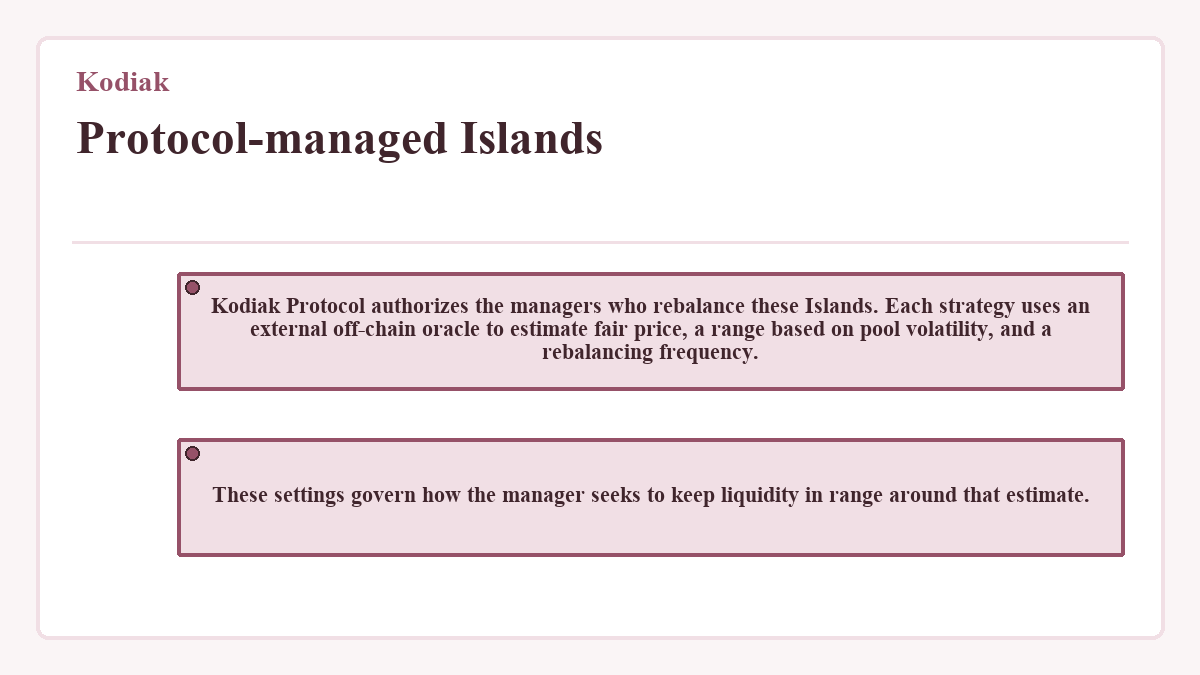
Kodiak Protocol authorizes the managers who rebalance these Islands. Each strategy uses an external off-chain oracle to estimate fair price, a range based on pool volatility, and a rebalancing frequency. These settings govern how the manager seeks to keep liquidity in range around that estimate.
Permissionless Islands
Anyone can deploy a permissionless Island around a fixed-range V3 position. Once deployment fixes the range, the Island cannot adjust those boundaries as prices move.
Protocol-managed and permissionless Islands each charge a manager fee of 10% of the liquidity-provider fees they generate. Choosing the fixed-range wrapper therefore retains this fee, even though its range cannot change after deployment.
A price move beyond a fixed band
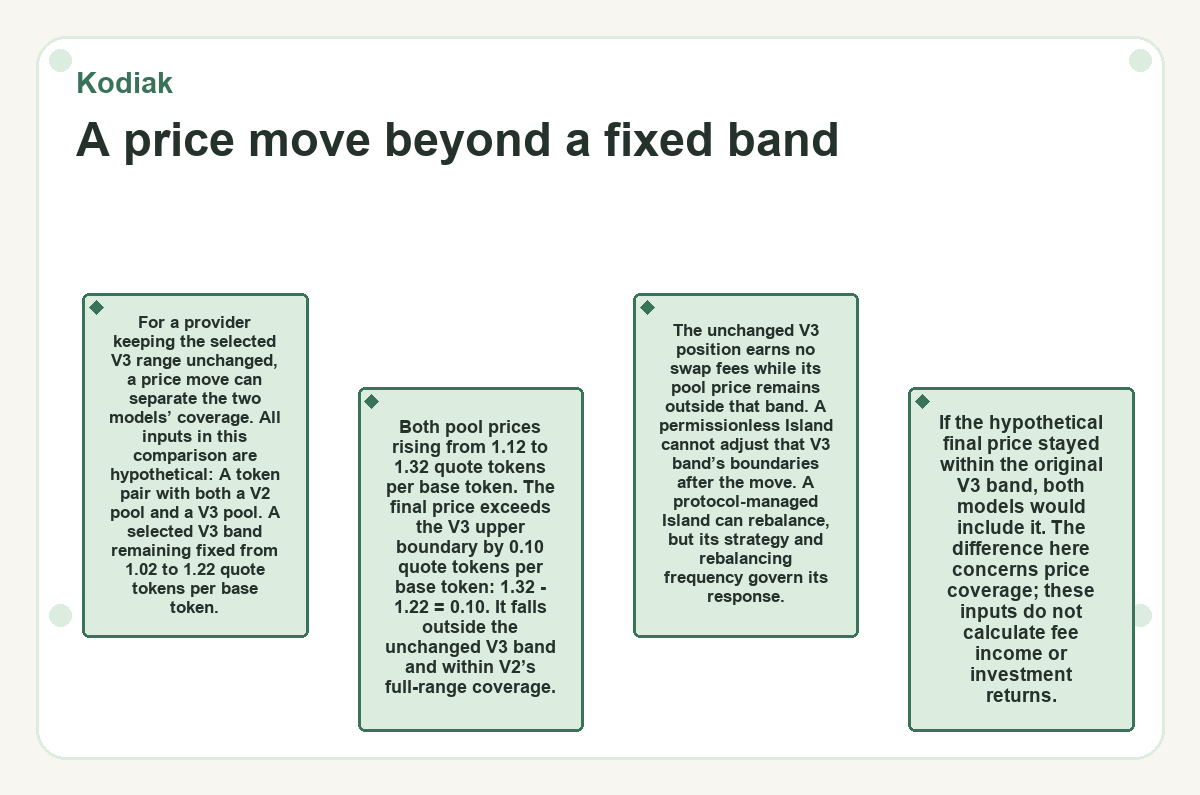
For a provider keeping the selected V3 range unchanged, a price move can separate the two models’ coverage.
All inputs in this comparison are hypothetical:
- A token pair with both a V2 pool and a V3 pool.
- A selected V3 band remaining fixed from 1.02 to 1.22 quote tokens per base token.
- Both pool prices rising from 1.12 to 1.32 quote tokens per base token.
The final price exceeds the V3 upper boundary by 0.10 quote tokens per base token:
1.32 - 1.22 = 0.10
. It falls outside the unchanged V3 band and within V2’s full-range coverage. The unchanged V3 position earns no swap fees while its pool price remains outside that band.
A permissionless Island cannot adjust that V3 band’s boundaries after the move. A protocol-managed Island can rebalance, but its strategy and rebalancing frequency govern its response.
If the hypothetical final price stayed within the original V3 band, both models would include it. The difference here concerns price coverage; these inputs do not calculate fee income or investment returns.