 Kodiak
 Islands: deposits and pool shares
How does a liquidity deposit become a pool share? An Island wraps a Kodiak V3 position and issues tokens representing each depositor’s proportional ownership of that position.
- Network
- Berachain
- Share format
- Fungible ERC-20 Island tokens
- Holder options
- Holders can transfer or trade the tokens, or redeem them for underlying assets at any time.
What changes behind the share?
The token represents a fraction of the underlying position, whose asset mix can change as swaps occur. Price movement within the position’s price range shifts the position’s relative holdings of the two pool assets.
Redemption returns underlying assets corresponding to the holder’s share of the position. The same Island-token balance can therefore represent different quantities of the pool assets over time.
Range management and manager fees
| Parameter | Documented value | Management and fee limits |
|---|---|---|
| Managed-Island fair-price reference | External off-chain oracle | Kodiak Protocol authorizes the parties who rebalance these Islands. |
| Managed-Island price range | Range around fair price, based on the underlying pool’s volatility | Each managed Island’s strategy also specifies its rebalancing frequency. |
| Permissionless-Island range updates | No range adjustment after deployment | Anyone can deploy this type of wrapper, but its range remains fixed afterward. |
| Manager fee | 10% of generated LP fees for both managed and permissionless Islands | The fee funds Island operating costs and applies to generated LP fees, not deposited capital. |
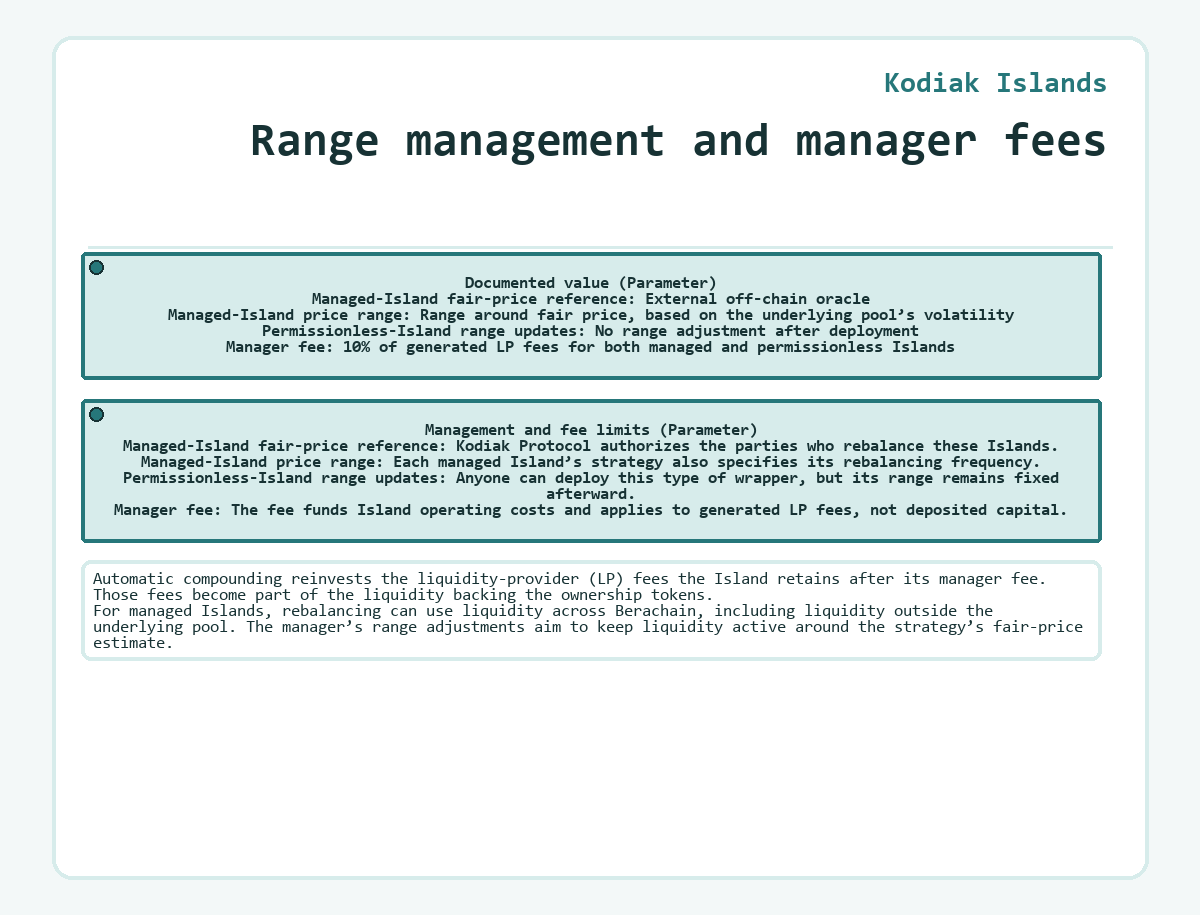
Automatic compounding reinvests the liquidity-provider (LP) fees the Island retains after its manager fee. Those fees become part of the liquidity backing the ownership tokens.
For managed Islands, rebalancing can use liquidity across Berachain, including liquidity outside the underlying pool. The manager’s range adjustments aim to keep liquidity active around the strategy’s fair-price estimate.
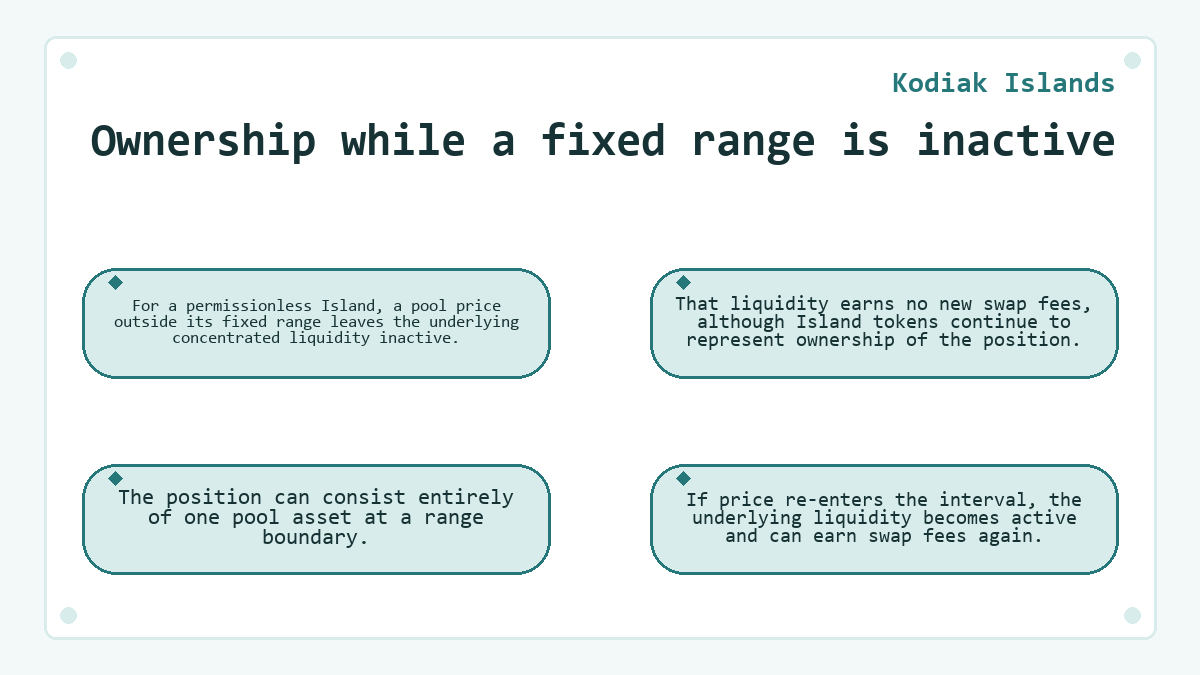
Ownership while a fixed range is inactive
For a permissionless Island, a pool price outside its fixed range leaves the underlying concentrated liquidity inactive. That liquidity earns no new swap fees, although Island tokens continue to represent ownership of the position.
The position can consist entirely of one pool asset at a range boundary. If price re-enters the interval, the underlying liquidity becomes active and can earn swap fees again.
Island tokens in reward vaults
Islands are compatible with Berachain Proof-of-Liquidity and eligible for Reward Vault whitelisting. That eligibility alone does not establish an active reward allocation for a particular Island.
For pools eligible for Proof-of-Liquidity incentives, staking Island tokens in a Berachain reward vault can earn WBERA rewards. A Bault adds a separate ERC-4626 vault layer above the Island. It accepts Island tokens, issues Bault receipt tokens, and compounds WBERA rewards into more Island tokens.